Three months ago, a homeowner in Naperville posted a 47-second video to a neighborhood Facebook group. She’s standing in her flooded basement at 11 p.m., phone in hand, scrolling through Google Maps results. “Five-star plumber, five-star plumber, another five-star plumber,” she narrates, voice shaking. “I’ve called six. Three went to voicemail. Two said they don’t actually service this zip code even though their listing says they do. One quoted me $850 just to show up.”
The video got 214 comments, most of them variations on “This is why I don’t trust Google anymore.”
That Naperville homeowner’s experience isn’t an anomaly. It’s the predictable outcome of a local search ecosystem where plumbing companies either don’t understand the mechanics of visibility or actively game them with tactics that erode trust for everyone.
The irony: the plumbers pouring money into Local Service Ads are often watching their organic Map Pack rankings slip because nobody’s fixed the foundational issues—NAP inconsistencies across directories, duplicate Google Business Profile listings, service area pages so thin they trigger spam filters.
I’m writing this because I’ve audited enough plumbing operations to know what actually moves the needle in local search. It’s a system—boring, measurable, and effective—that aligns what Google rewards with what anxious homeowners actually need when they’re standing in water at midnight.
The 90-Second Decision Window: What Happens Between Search and Call
When someone searches “emergency plumber near me” at 10:47 p.m., they’re in triage mode.
The decision loop is brutal: scan the Map Pack, tap the first listing that looks legitimate, check if the phone connects to a human, assess competence, ask about availability and pricing, then either book or move to the next listing. The entire sequence takes ninety seconds if the business answers.
Google knows this. The Map Pack algorithm prioritizes signals that predict whether a business will actually fulfill the searcher’s intent—not whether it has the most backlinks, but whether it’s operationally present and trustworthy enough to convert that panicked tap into a completed service call.
What Google Actually Measures
| Signal Type | What It Tells Google | Why It Matters |
|---|---|---|
| NAP Consistency | Business exists as single entity | Foundation for all other signals |
| Response Rate | Someone monitors the listing | Predicts call conversion |
| Review Specificity | Real customers, real experiences | Authenticity indicator |
| Structured Data | Exact services in exact locations | Relevance matching |
| Profile Completeness | Operational legitimacy | Trust proxy |
Proximity matters, but it’s table stakes. The real differentiators suggest operational legitimacy: a verified Google Business Profile with consistent NAP data, a response rate indicating active monitoring, reviews mentioning specifics (arrival time, transparent pricing, actual problem solved), and structured data helping Google understand exactly what services you offer where.
I’ve watched plumbing companies spend $3,000 monthly on Local Service Ads while their organic Map Pack presence collapses because their Google Business Profile lists an address that doesn’t match their website footer, which doesn’t match their Yelp listing, which doesn’t match the citation they bought from a directory service in 2019. Google sees that inconsistency and downgrades the confidence score on the entire entity.
NAP Consistency: The Foundation That Everything Else Depends On
The fix starts with making sure your business exists as a single, coherent entity across every platform where Google checks for validation. That means your exact business name, exact street address, and exact phone number need to match everywhere.
Everywhere means:
- Your Google Business Profile
- Your website’s contact page and footer
- Your Schema.org LocalBusiness markup
- Your citations in major directories like Yelp and the Better Business Bureau
- Any industry-specific platforms like Angi or HomeAdvisor
I run this audit for every plumbing client in the first week. Last month, a client in Schaumburg had 11 different phone numbers floating around the web because they’d changed their main line three times and never updated old listings. Google couldn’t confidently connect the business to a single entity.
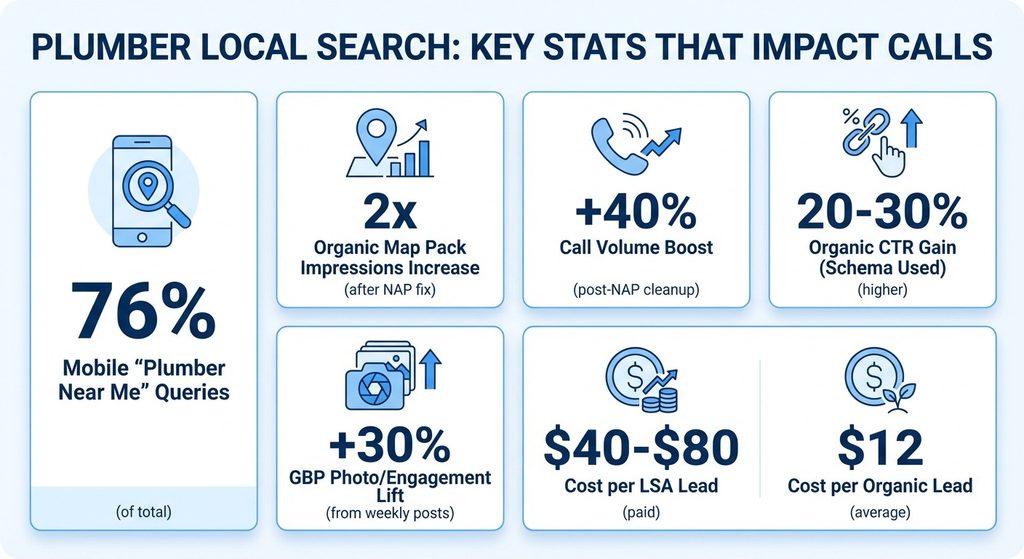
We spent two weeks cleaning citations and consolidating to a single tracking number that forwards to their main line. Their Map Pack impressions doubled in 28 days, and call volume from organic search went up 40%. No new content, no new backlinks—just operational consistency that let Google trust the entity.
Your Google Business Profile: The Storefront 76% of Searchers See First
Your Google Business Profile isn’t a listing. It’s your storefront for everyone searching on mobile, which is 76% of “plumber near me” queries. When someone taps your pin in the Map Pack, the GBP panel that slides up is where they decide whether to call, visit your website, or bounce.
Most plumbing companies treat this like a set-it-and-forget-it form they filled out in 2018.
The Verification Trap
Start with verification. If your GBP isn’t verified, you’re invisible. If you verified years ago but never claimed ownership after a business name change or address move, you might have a duplicate listing competing with yourself.
Consolidate to a single verified profile and make sure the verification address matches your actual business location.
Complete Every Field (Yes, Every Single One)
Google’s algorithm uses completeness as a proxy for legitimacy. Complete these fields:
- Business name, address, phone, website
- Hours (including holiday hours and emergency availability)
- Service areas
- Business categories (primary and secondary)
- Attributes (veteran-owned, women-led, emergency services)
- Business description explaining what you do and where you serve without keyword-stuffing
Photos: The Trust Signal Most Plumbers Ignore
Businesses with photos receive more clicks and direction requests. But it’s not just quantity—it’s recency and relevance. Upload photos of your actual team, trucks with visible branding, actual work (before-and-after installations, repairs in progress). Avoid stock photos.
Upload at least one new photo weekly. It signals operational activity and gives Google fresh content to associate with your entity.
GBP Posts: The Feature Nobody Uses (But Should)
Posts are the most underutilized GBP feature. You can publish updates directly to your profile—service announcements, seasonal tips, special offers, explanations of common plumbing issues. These posts appear in your GBP panel and search results, and Google uses engagement with them as a ranking signal.
A plumber in Aurora started posting weekly “winter prep” tips in November—short, practical posts about preventing frozen pipes, checking water heater settings, inspecting sump pumps. Their GBP engagement metrics jumped 30% during that period, and they booked 18 inspections directly attributed to the posts.
The Q&A Section: Where Trust Gets Built or Destroyed
Homeowners ask questions directly on your GBP—”Do you offer free estimates?” “What’s your emergency call-out fee?” If you don’t answer, someone else might, and their answer might be wrong. Monitor your Q&A weekly, answer every legitimate question with specifics, and pre-seed the section with questions you know homeowners care about.
For plumbing businesses specifically, seo for plumbers requires understanding that your GBP is where the majority of your local search conversions happen. Optimizing it isn’t a one-time task—it’s an ongoing operational discipline.
Service Area Pages: Proving Coverage Without Triggering Spam Filters
Most plumbing websites claim to serve a 30-mile radius but have zero on-site content proving it to Google. The homepage says “Serving Greater Chicago,” the footer lists 15 suburbs, and that’s it. No dedicated pages for those suburbs, no structured data telling Google which services you offer where.
Google sees this and treats your service area claim with skepticism.
The Right Way vs. The Spam Way
The wrong way: Create 15 identical pages, swap out the city name in the H1, and hope Google doesn’t notice. Google notices. It’s doorway page spam.
The right way: Create genuinely unique pages for each service area that include specific local information—landmarks, neighborhoods, common plumbing issues specific to that region (older housing stock with cast iron pipes, newer developments with PEX plumbing, areas with hard water requiring specific solutions).
I worked with a plumber in Joliet who wanted to rank in Plainfield. We built a Plainfield service page including the area’s housing demographics (mix of 1970s ranch homes and new construction), common service calls from that zip code (sump pump failures due to high water tables, sewer line issues in older neighborhoods with clay pipes), and three anonymized case studies.
We added Schema.org markup specifying Plainfield as a service area with offered plumbing services. Within six weeks, they started appearing in the Plainfield Map Pack.
Schema Markup: Speaking Google’s Language
Schema.org markup is the language you use to communicate with Google’s algorithm in a format it can parse without ambiguity. For plumbing businesses, the most important schema types are LocalBusiness (or Plumber subtype), Service, and AggregateRating.
Common mistakes include marking up a service area as a single city when you serve multiple areas, failing to specify business type, including schema only on the homepage, or marking up reviews that don’t exist on your site.
The payoff for correct implementation is significant. Google uses schema to generate rich results—enhanced search listings with star ratings, price ranges, and service details. In my tracking across client accounts, pages with correctly implemented schema see 20-30% higher organic CTR than identical pages without markup.
Reviews: What Google’s Algorithm Actually Analyzes
Every plumber knows reviews matter. What most don’t understand is that Google’s algorithm analyzes review velocity, recency, response rate, response time, and review content (whether reviews mention specific services, locations, and outcomes).
Recency Beats Volume
A business with 200 reviews but none in the last six months looks stagnant. A business with 30 reviews, five posted in the last 30 days, looks active and trustworthy. Google’s algorithm favors recency because it signals current operational status.
The Request System That Works
Text or email the customer within 24 hours of completing the job, thank them, and include a direct link to your Google review page. Keep the message short and personal. Don’t offer incentives (Google prohibits this). Just make it easy.
Response Rate: The Engagement Signal You’re Ignoring
Response rate is where most plumbing companies fail. They respond to negative reviews (sometimes defensively) and ignore positive ones. Google’s algorithm tracks whether you respond to reviews and uses it as an engagement signal.
For positive reviews, a simple “Thanks for trusting us with your plumbing repair, [Name]. We’re glad we could help” is sufficient. For negative reviews, acknowledge the issue, apologize if appropriate, offer to make it right, and take the conversation offline. Never argue in public.
Content Quality: Specificity Signals Authenticity
Generic reviews (“Great service!”) help your star rating but don’t provide specificity that builds trust. Reviews mentioning specific services (“They replaced our water heater in three hours”), specific locations (“Came to our house in Wheaton the same day”), and specific outcomes (“Fixed the leak and the price was exactly what they quoted”) are more valuable.
Google can parse this content and associate your business with those services and locations, improving relevance for related searches.
Citations and Backlinks: The Validation Layer Google Cross-Checks
Local citations—mentions of your business name, address, and phone number on other websites—function as validation signals. When the algorithm sees your NAP consistently referenced across multiple trusted directories, it increases confidence that your business is real and legitimate.
The Citation Hierarchy
Tier 1 – Major Directories:
- Google Business Profile
- Yelp
- Better Business Bureau
- Angi
- HomeAdvisor
- Thumbtack
- Plumbing-Heating-Cooling Contractors Association (PHCC)
Claim your listings on each platform, ensure NAP is identical across all, and keep profiles updated.
Tier 2 – Local Directories:
- Your city’s chamber of commerce
- Local business associations
- Neighborhood directories
- Local news sites maintaining business listings
Focus on directories relevant to your industry or location, with editorial standards, that homeowners might actually use. Avoid bulk citation services submitting to 200 low-quality directories.
Backlinks: Authority Signals That Compound Over Time
Backlinks—links from other websites to yours—are authority signals. When a local news site links to your blog post about preventing frozen pipes, or when a real estate agent links to your services page, Google interprets that as a vote of confidence.
Tactics that generate local backlinks:
- Sponsor a little league team and get a link from the league website
- Write a seasonal maintenance guide and pitch it to local news sites
- Partner with real estate agents, property managers, or home inspectors who might link to your services
- Offer to be quoted as a local expert for home maintenance articles
One tactic that works: create neighborhood-specific content that local websites want to link to. A plumber in Naperville created a guide to “Common Plumbing Issues in Naperville’s Historic District” covering specific challenges of maintaining plumbing in homes built in the 1920s-1940s. Local real estate agents started linking to it when selling homes in that district. The page generated 12 backlinks in six months, all from local, relevant sources.
The Metrics That Actually Predict Revenue
Most plumbing companies measure SEO success by tracking their Google ranking for “plumber [city name]” and calling it done. That’s a vanity metric. What matters is whether your local search presence generates qualified leads at a cost that makes sense.
GBP Insights: The Dashboard Most Plumbers Never Check
Google Business Profile insights show exactly how people find and interact with your listing. Track impressions (how often your listing appears), actions (calls, website clicks, direction requests), and where impressions come from (direct search for your business name vs. discovery search for generic terms).
If impressions are growing but actions are flat, your listing is visible but not compelling—fix your photos, description, and reviews. If actions are growing but conversion rate is dropping, you’re attracting unqualified leads—tighten your service area targeting.
Call Tracking: The ROI Calculator You Need
Use a call tracking number that forwards to your main line and tracks which source generated each call—organic search, Local Service Ads, direct traffic. This lets you calculate cost per lead for each channel and make informed budget decisions.
Conversion Rate: Are You Attracting the Right Searchers?
Conversion rate from organic leads tells you whether your local SEO attracts the right audience. If you’re getting 50 calls monthly from organic search but only booking 10 jobs, either your call handling needs work or you’re ranking for keywords attracting unqualified searchers.
Local Service Ads: When Paid Makes Sense (and When It Doesn’t)
Local Service Ads are Google’s pay-per-lead platform for home services, appearing above the Map Pack with a green “Google Guaranteed” badge. They’re effective for generating immediate leads, especially for new businesses. But they’re expensive—leads typically cost $40-$80—and they don’t build long-term organic visibility.
The Strategic Use Case
LSAs work best as a short-term visibility boost while building your organic presence. If you’re a new plumbing business with no reviews, no citations, and no Map Pack visibility, LSAs can generate leads immediately while you work on GBP optimization, citation building, and review accumulation.
The Trap: Paid-Only Dependency
The mistake: plumbing companies treat LSAs as their primary lead source and neglect organic entirely. They spend $5,000 monthly on LSAs, generate 80 leads, book 30 jobs, and think they’ve found a sustainable model. Then Google changes the LSA algorithm or increases competition, and cost per lead jumps from $60 to $95.
The Blended Approach
The smarter approach: use LSAs to generate immediate cash flow and customer reviews while simultaneously building your organic foundation. Every LSA customer is an opportunity for a Google review, which strengthens your Map Pack ranking.
Track your blended cost per lead across all channels and aim to decrease it over time by shifting more volume to organic. A healthy local search strategy might be 60% organic leads, 25% LSAs, 15% other channels.
The homeowner in the flooded basement doesn’t care about your SEO strategy. She cares about finding someone who will show up, fix the problem, charge a fair price, and not make her feel stupid for calling. The plumber who dominates local search is the one whose online presence answers those concerns before she even makes the call—verified business, consistent information, recent reviews mentioning transparent pricing and reliable service, and a GBP that makes it easy to call or get directions.