
I keep seeing the same question in YouTube threads every week: “Should I spend on SEO or just hire another tech?”
And every time, I want to reach through the screen and ask: What’s actually broken right now?
Because here’s the expensive truth—if you’re stuck between $10k and $25k a month with solid retention but inconsistent leads, messy scheduling, and sleepless nights about hiring, you’re probably diagnosing the wrong bottleneck. I spent three years running operations for a 12-truck termite and general pest company, and I watched us burn $8,000 on Google Ads before we fixed what was actually choking growth.
It wasn’t lead volume. It was lead conversion and the fact that our Google Business Profile looked like we’d given up in 2019.
The Real Bottleneck: Capacity vs. Credibility vs. Conversion
Most owners I work with—independent operators doing $15k to $20k monthly—think their problem is “not enough leads.” But when we pull the numbers, here’s what we find:
| Funnel Stage | Typical Numbers | Conversion Rate |
|---|---|---|
| Monthly Calls | 40-60 | – |
| Booked Appointments | 18 | 55% booking rate |
| Closed Sales | 10 | 25% close rate |
| Retained Customers | 7 | 30% lost to issues |
That’s a 25% close rate and 55% booking rate. The problem isn’t lead volume; it’s leakage at every handoff, plus a Google Business Profile that makes you look smaller than you are.
Industry benchmarks confirm that 61% of pest control companies say growing revenue is their #1 goal—but most are pouring money into the wrong funnel stage. Before you buy another HomeAdvisor lead pack or hire a tech you can’t keep busy, answer three questions in order:
The Three-Question Framework
Question 1: Do people trust you when they find you?
This is about credibility—your Google Business Profile, reviews, and branding.
Question 2: Are you converting the leads you already get?
This is about conversion—call tracking, follow-up systems, and CRM infrastructure.
Question 3: Can you handle more volume without breaking quality?
This is about capacity—scheduling, compliance, and hiring systems.
If you skip straight to capacity without fixing credibility and conversion first, you’re just paying to expose your weak points faster.
Step One: Build Durable Lead Generation Through Google Business Profile and Local SEO
This is where I tell every client to start, and it gets the most pushback because it feels slow.
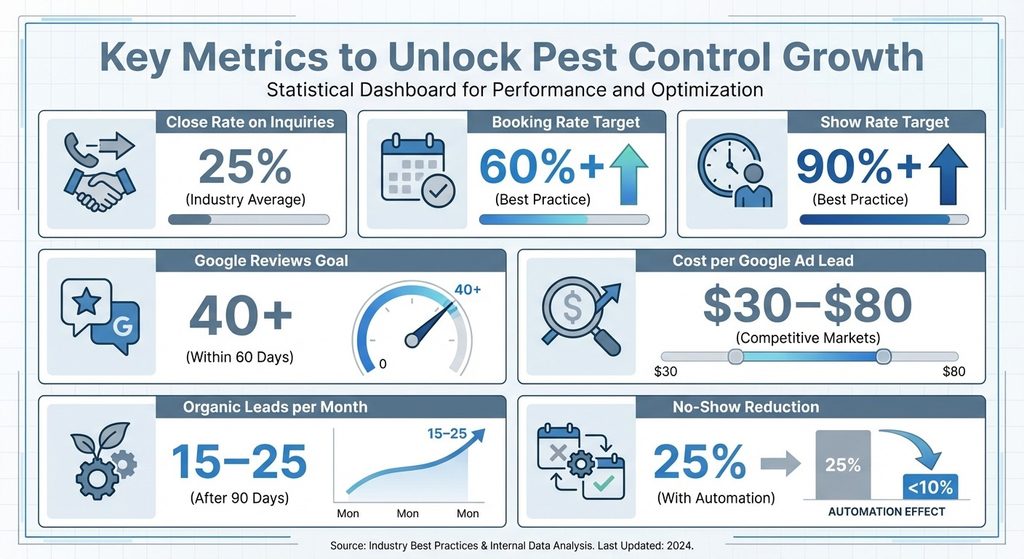
But here’s the math: a fully optimized Google Business Profile with 40+ recent reviews, weekly posts, and accurate service-area targeting will generate 15–25 qualified local calls per month within 90 days, with zero ongoing ad spend. Compare that to a $1,200/month Google Ads budget that might get you 30 clicks and eight calls—half of which are price-shoppers or out-of-area.
Your GBP is the single highest-leverage asset you own. When someone searches “termite inspection near me,” Google shows three local results. If you’re not in that map pack, you’re invisible to 70% of local search traffic. And if your profile has six reviews from 2022 and blurry photos, you look barely in business.
The Four-Week GBP Build Plan
Week 1–2: Profile foundation
Claim and verify your GBP. Fill out every field—services (list each one: termite inspection, rodent control, mosquito treatment), service areas (specific zip codes, not just “Chicago area”), business hours, attributes (veteran-owned, locally-owned, emergency service).
Upload 20+ high-quality photos: your truck with logo visible, techs in branded gear, before-and-after shots, your office or warehouse.
Week 3–4: Content and posting
Start weekly Google Posts (150–200 words): seasonal tips (“Why you’re seeing more ants in spring”), service highlights (“Our termite inspection process”), local tie-ins (“Serving [neighborhood] for 8 years”).
Posts signal activity to Google’s algorithm and give prospects a reason to trust you’re current.
Ongoing: Review velocity and Q&A
You need 3–5 new reviews per month, minimum.
After every completed service, send a text with a direct review link. Respond to every review within 24 hours. Monitor and answer Questions in your GBP—prospects ask “Do you offer same-day service?” or “Are your treatments pet-safe?”
If you don’t answer, someone else will.
The data backs this up. Market growth shows the Global Pest Control Market is projected to reach USD 14.10 Billion by 2035, and most growth is being captured by operators who show up in local search and look credible when they do.
You don’t need a $5,000 SEO agency retainer. You need to do the blocking and tackling on your GBP every single week.
Local SEO Beyond GBP: Citations, Content, and Backlinks
Once your GBP is active, layer in three supporting tactics:
Citations: Get listed consistently (same name, address, phone) on Yelp, Angi, Thumbtack, Yellow Pages, local chamber directories.
Localized website content: Create service pages for each major offering and each service area. Not just “Termite Control” but “Termite Inspection and Treatment in [City/Neighborhood].” Include local keywords naturally, add photos from jobs in that area, and answer common questions. This is where digital marketing pest control companies can help if you don’t have time—but you can start with one well-written page per quarter.
Backlinks from local sources: Sponsor a little league team and get a link from their site. Write a guest post for a local home services blog. Each quality local backlink tells Google you’re embedded in the community.
Track progress with Google Search Console (free) and GBP Insights. Watch for: search impressions, click-through rate, direction requests, and phone calls.
Step Two: Convert Leads You’re Already Getting—The CRM and Follow-Up System
Here’s what keeps me up at night: clients spending $800/month on ads, getting 25 calls, booking 12 appointments, and then seven of those twelve no-show or reschedule indefinitely.
That’s not a lead problem. That’s a follow-up problem, and it’s costing you $400 in wasted ad spend monthly.
You need a CRM—not because it’s trendy, but because it’s the only way to stop losing 30–40% of your pipeline to forgotten follow-ups. I recommend PestPac, ServSuite, or FieldRoutes if you want the full field service suite; or GoHighLevel or HubSpot if you’re comfortable with setup.
The goal is to capture every lead (phone, web form, text), assign it a status, and automate reminders so nothing falls through.
The Five-Step Conversion System
Step 1: Lead capture
Every phone call gets logged (use a call tracking number so you know which marketing source it came from). Every web form submission triggers an instant text: “Thanks for reaching out! We’ll call you within 2 hours to schedule your inspection.”
Step 2: Speed to contact
If you wait 24 hours to return a call, your close rate drops by half. Aim for under 2 hours, ideally under 30 minutes.
Step 3: Appointment confirmation
Two days before the appointment, send an automated text: “Hi [Name], confirming your termite inspection on [Date] at [Time]. Reply YES to confirm or call to reschedule.”
Day-of, send a “Tech is on the way” message with their name and photo. This cuts no-shows from 25% to under 10%.
Step 4: Post-service follow-up
Same day or next day, send a “How did we do?” message with a review link. Three days later, if they haven’t left a review, send a gentle nudge. Thirty days later, send a “Time for your quarterly service?” reminder.
Step 5: Weekly metric tracking
Track three metrics weekly:
- Booking rate (calls to scheduled appointments—target 60%+)
- Show rate (scheduled to completed—target 90%+)
- Close rate (completed to paying customer—target 70%+)
If any is low, you know exactly where to focus.
Step Three: Build Trust Through Reviews and Reputation Management
You can have the best GBP and tightest follow-up system, but if you have 12 reviews and three are one-star complaints about missed appointments, you’re losing 60% of prospects before they ever call.
Reviews are your credibility currency. In pest control—where trust is already low because of bad actors—they’re the difference between “I’ll call them” and “I’ll keep looking.”
The Review Benchmark
Target: 40+ Google reviews with a 4.5+ average, and at least 10 from the last 60 days.
Why? When someone compares you to Terminix (300 reviews at 3.8 stars), and you have 45 reviews at 4.7 stars with recent, detailed responses, you look like the local expert who cares.
The Review-Generation System
After every completed job, send a two-step ask:
First message (same day): “Thanks for trusting us with your [service]. How did we do?”
Second message (next day, if positive response): “Would you mind sharing your experience on Google? Here’s the link: [direct review URL].”
Make it frictionless—one click, no login required.
Incentivize your team. Every tech who generates five Google reviews in a month gets a $50 bonus. Track it on a whiteboard.
Handling Negative Reviews
Respond within 24 hours, publicly, with empathy: “Hi [Name], I’m sorry we missed the mark. I’d like to make this right—please call me directly at [your cell].”
Take the conversation offline, fix the issue if possible, and ask if they’d consider updating their review. About 40% will. Even if they don’t, future prospects see that you care.
When to Choose Paid Ads vs. Organic Growth—and What Each Actually Costs
Now we get to the question that starts half the YouTube arguments: “Should I run Google Ads or just focus on SEO?”
The answer depends on where you are in the growth curve.
Organic vs. Paid: A Comparison
| Factor | Organic (GBP + Local SEO) | Paid Ads (Google/Facebook/LSAs) |
|---|---|---|
| Time to Results | 60-90 days | Days to weeks |
| Monthly Cost | $200-$500 (consulting/content) | $1,200-$3,000+ (ad spend) |
| Cost Per Lead | Near-zero marginal cost | $30-$80 per lead |
| Lead Quality | High (local, intent-driven) | Mixed (50% qualified) |
| Durability | Compounds over time | Stops when budget stops |
| Best For | $10k-$20k/month operators | $25k-$50k/month operators |
Organic: Slower to ramp, but durable and cost-effective long-term. You’re investing time and maybe $200–$500/month for a local SEO consultant or content writer. Once you’re ranking in the map pack with strong reviews, you get 15–30 qualified calls per month with near-zero marginal cost.
Best for: operators at $10k–$20k/month who need consistent lead flow and can’t afford to burn $1,500/month testing ads.
Paid ads: Faster to generate volume (leads within days), but expensive and requires active management. Expect $30–$80 per lead in competitive markets, and maybe 50% of those leads are qualified.
Best for: operators at $25k–$50k/month who have conversion dialed in (80%+ booking rate, 70%+ close rate) and need to fill new tech capacity fast.
The Hybrid Approach I Recommend
Start with organic. Get your GBP and review system humming, track your conversion rates, and build a baseline of 15–20 organic leads per month.
Once you’re consistently closing 70%+ of those and have capacity to handle more volume, layer in a small ad test—$500–$800/month, tightly geo-targeted, with call tracking.
Scale ad spend only when the unit economics make sense: if your average customer lifetime value (LTV) is $600 and your cost per acquisition (CPA) via ads is $120, you have room to grow. If your CPA is $200 and your LTV is $400, you’re in trouble.
One more thing: Local Service Ads (Google Guaranteed) can be a middle ground. You pay per lead (usually $15–$40), Google vets you with a background check, and you get a “Google Guaranteed” badge. Conversion rates are often higher because lead quality is better.
Hiring and Scaling Capacity: When to Add a Tech and How to Avoid the Quality Drop
You’ve built durable lead gen, your conversion is solid, and you’re consistently booking 25–30 jobs per month.
Now the question is: Can you handle more volume without breaking what’s working?
This is where I see the most expensive mistakes. Owners hire a tech too early, or they hire the wrong person, or they don’t have systems in place to train and monitor quality.
Three months later, they’re dealing with bad reviews, compliance issues, and the new tech is either gone or costing them customers.
The Decision Point
Hire when you’re consistently turning away work or pushing appointments out 10+ days because you’re booked solid.
If you’re at $20k/month working 60-hour weeks with a waitlist of 15–20 customers, that’s the signal. But before you post the job, you need three things:
1. Standard operating procedures (SOPs)
Written checklists for every service type—initial inspection, treatment application, follow-up, customer communication.
2. A training and shadowing plan
Minimum two weeks of ride-alongs before they go solo. Build in review checkpoints: after job 5, after job 20, after 60 days.
3. A quality and compliance tracking system
Use your CRM to log: customer satisfaction scores (ask every customer to rate 1–5 after service), re-service rates (if you have to come back for the same issue within 30 days, that’s a quality flag), and compliance checks (are they documenting pesticide applications correctly, wearing PPE, following label instructions).
Subs vs. Employees: The Decision Matrix
Subcontractors give you flexibility (pay per job, no benefits, easy to scale), but you lose control over quality and branding, and in many states, misclassifying employees as subs can trigger labor law issues.
Employees cost more upfront (payroll taxes, workers’ comp, benefits), but you control training, quality, and customer experience.
My rule: if this person will be doing 80+ jobs per month and representing your brand directly, hire them as an employee. If it’s overflow or specialized work, sub is fine.
Leveraging AI Tools and Automation to Scale Without Losing the Personal Touch
Technology adoption is accelerating, with a 32% increase in smart pest monitoring systems—but the bigger opportunity for small operators isn’t fancy IoT traps; it’s using AI to automate the repetitive stuff so you can focus on high-value interactions.
Four AI Tools Worth Your Time
1. AI-powered call handling and scheduling
Tools like Smith.ai or Hatch can answer your phone 24/7, qualify leads, and book appointments directly into your calendar.
Cost: $200–$500/month.
ROI: You stop missing after-hours calls (often the highest-intent leads), and you free up 5–10 hours per week of admin time.
2. Automated follow-up sequences
Your CRM can send personalized text and email sequences based on triggers: lead came in but didn’t book? Send a three-touch sequence over five days. Customer completed service but didn’t leave a review? Send a two-touch sequence.
You set it up once; it runs forever.
3. Content creation for social and GBP posts
Tools like ChatGPT or Jasper can help. Need a weekly Google Post about “Why you’re seeing more spiders in fall”? Feed the AI a prompt, edit for your voice, add a local tie-in, and publish in 10 minutes instead of an hour.
4. Route optimization and scheduling
Software like FieldRoutes or ServiceTitan uses algorithms to build efficient daily routes, reducing drive time by 15–20%. That’s an extra job per day per tech, which is $8,000–$12,000 in additional revenue per month.
The Mindset Shift
Automation isn’t about replacing the human touch; it’s about freeing you up to add human touch where it matters—on the phone with a nervous homeowner, on-site explaining treatment options, following up personally after a tough job.
Automate the repetitive; personalize the critical.
The 90-Day Roadmap: What to Do First, Second, and Third
Here’s the sequence I walk every client through, designed to build momentum without burning cash or overwhelming your schedule:
Days 1–30: Foundation
Focus: GBP, reviews, call tracking
Actions:
- Claim and optimize your Google Business Profile
- Set up call tracking (CallRail, $45/month)
- Implement a review-request system (text or email after every job)
Goal: 5–10 new reviews, GBP fully populated
Investment: $100–$200 | 10 hours total
Days 31–60: Conversion System
Focus: CRM, follow-up automation
Actions:
- Choose and set up a CRM
- Build your lead-to-customer workflow: capture, contact, confirm, close, follow-up
- Train your team on logging every interaction
Goal: 60%+ booking rate, 90%+ show rate
Investment: $100–$300/month for CRM | 15 hours setup, then 2 hours/week
Days 61–90: Scale Test
Focus: Content, local SEO, or small ad test
Actions:
- Add localized service pages to your website
- Start weekly GBP posts
- If conversion is strong and you have capacity, test $500 in Google Ads or LSAs
Goal: 25–35 qualified leads per month, 70%+ close rate
Investment: $500–$1,000 (content + ads) | 5 hours/week
What You’ll Have by Day 90
By day 90, you should have: a credible online presence, a system that converts 60–70% of inquiries into paying customers, and enough lead flow to either fill your current capacity or justify hiring.
That’s when you revisit the hiring question—not before.
The companies that win in this market aren’t the ones with the biggest ad budgets or the most trucks. They’re the ones who show up consistently in local search, convert leads efficiently, deliver quality service, and build a reputation that compounds month over month.
That’s the durable growth model, and it’s available to every operator who’s willing to do the work in the right order.