Last month I watched a roofing contractor I’ve known for fifteen years take on three commercial jobs at once. Good guy. Solid crew. Twenty years of clean work in the market.
Six weeks later he was sitting in my office asking if we had any spare PMs because his scheduler quit, two foremen walked, and he’d just written a $47,000 check to fix callbacks on jobs his new hires botched.
“I thought I was ready,” he said. “We had the contracts. We had the cash flow. What the hell happened?”
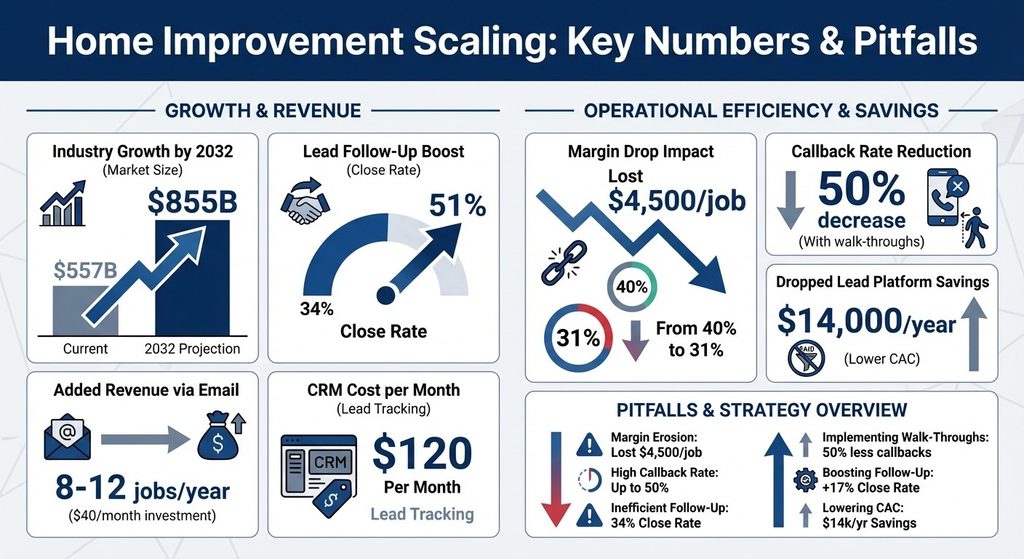
What happened is what always happens: he scaled revenue without scaling the handoffs. The market’s growing—industry forecasts show the home improvement sector climbing from $557 billion to nearly $855 billion by 2032—but bigger contracts don’t automatically mean better operations. They just mean more places for things to break.
I spent the last eighteen months stabilizing a 30% growth year at our shop without losing our lead carpenter or our reputation. The answer isn’t motivational. It’s mechanical.
Scaling is about controlling five handoffs—lead to estimate, estimate to contract, contract to production, production to closeout, closeout to feedback—so quality doesn’t slip when volume rises. Miss one handoff and you’re writing five-figure checks to fix someone else’s mess.
The Myths That Kill Mid-Size Shops
You’ve heard the advice. “Hire great people.” “Invest in marketing.” “Use better software.” All true. All useless without context.
Here’s what actually breaks first when you add two crews: your estimating accuracy drops because your lead estimator is now covering twice the territory and rushing site visits. Your project managers start missing material orders because they’re juggling eight jobs instead of four. Your best foreman gets pulled into babysitting new hires instead of running his own crew.
I’ve seen owners blame their crews. Blame their software. Blame the market. But the real problem is simpler: they scaled the front end—sales, marketing, lead gen—without scaling the operations that turn a signed contract into a finished job.
The myth that “systems kill craftsmanship” comes from people who’ve only seen bad systems. Good systems don’t replace judgment. They reserve judgment for the moments that need it. Your foreman shouldn’t be deciding which supplier to call or whether the contract covers that change. He should be solving the field problem in front of him while the system handles the routine handoffs.
The Unit Economics Nobody Wants to Track
Before you hire anyone or sign anything, you need to know three numbers for every job type you run:
- Gross margin
- Labor hours per square foot (or per unit)
- Callback rate
Not averages. Actual ranges by crew, by season, by project type.
We track this in a simple spreadsheet—job name, contract value, actual material cost, actual labor hours, any callbacks within 90 days. Every month I sort by gross margin and look for patterns. Kitchen remodels with our lead crew: 42-48% margin, consistent. Same scope with the newer crew: 31-39% margin, and twice the callback rate. That’s a training and supervision problem.
The Math That Actually Matters
If your average job grosses $50,000 and your target margin is 40%, you’re working with $20,000 to cover labor, overhead, and profit. Let’s say labor is $12,000 and overhead is $5,000. You’ve got $3,000 profit per job.
Add a crew that runs at 31% margin instead of 40% and you just lost $4,500 per job—more than your entire profit. Do that five times and you’ve burned $22,500 while working harder.
Now add callbacks. Every callback costs you the labor to fix it (usually 8-16 hours at $45-65/hour loaded) plus the project manager’s time to coordinate it, plus the reputational hit. A single callback can erase the profit on a $30,000 job.
This is why scaling isn’t about landing bigger contracts. It’s about maintaining margin and quality as volume increases. And the only way to do that is to control the handoffs that create variance.
The Five Handoffs That Control Quality at Scale
Every job in your company moves through five transitions. Each transition is a place where information gets lost, expectations shift, or someone makes an assumption that costs you money.
Handoff #1: Lead to Estimate
Someone calls or fills out a form. Who responds? How fast? What questions do they ask before scheduling the site visit?
We have a rule: every inbound lead gets a call within two hours, and the person making that call uses a three-question script to qualify scope, timeline, and budget before we send an estimator. That script cut our estimating waste by 40%.
Handoff #2: Estimate to Contract
Your estimator walks the site, takes measurements, writes a proposal. How does that proposal get to the customer? Who follows up?
This is where most shops lose deals—not because their price is wrong, but because the follow-up is slow or inconsistent. We use a CRM to automate the follow-up sequence: proposal sent, day-three check-in, day-seven final call. Our close rate went from 34% to 51% just by making the follow-up predictable.
Handoff #3: Contract to Production
Customer signs. Now what? Who orders materials? Who schedules the crew? Who confirms access and site conditions? This handoff is where change orders breed. If your PM doesn’t walk the site with the contract in hand and confirm every detail before the crew shows up, you’re going to burn hours fixing assumptions. We built a pre-production checklist—22 items, takes 30 minutes, saves us an average of eight hours per job.
Handoff #4: Production to Closeout
The work’s done. Who inspects it? Who walks the customer through the final punch list? Who collects payment and asks for the review?
Most crews just finish and leave. That’s how you get surprise callbacks three weeks later. Our foremen now do a walkthrough with the homeowner before they pack up. It adds 45 minutes to the job and cuts our callback rate in half.
Handoff #5: Closeout to Feedback
Job’s closed, payment’s in. Do you track what went right and wrong? Do you feed that back into estimating and training? We have a simple form the PM fills out within 48 hours of closeout: what was the actual margin, were there any surprises, what would we do differently next time. That data goes into a quarterly review where we adjust our estimating assumptions and training priorities.
These five handoffs are where quality lives or dies. You can have the best craftspeople in the market, but if the handoffs are sloppy, you’ll scale into chaos.
The Operating Stack: What Software Actually Does on a Jobsite
Let’s talk tools. Not because I’m selling anything, but because I’m tired of watching owners buy software they don’t use or use software that doesn’t fit how they actually work.
| Tool Category | Purpose | What to Look For | Cost Range |
|---|---|---|---|
| CRM | Lead-to-contract tracking | Automated follow-up sequences, mobile access | $100-200/month |
| Project Management | Contract-to-closeout workflow | Mobile field updates, photo documentation, schedule tracking | $50-100/user/month |
| Lead Generation | Inbound customer acquisition | Channel-specific tracking, fast response integration | Variable per lead |
| Feedback Systems | Closeout-to-improvement loop | Simple surveys, review requests, data aggregation | $0-50/month |
| Marketing Automation | Customer reactivation | Email sequences, past-customer targeting | $30-60/month |
CRM (Customer Relationship Management)
This is your lead-to-contract system. It tracks every inquiry, every estimate, every follow-up. The goal isn’t to automate everything—it’s to make sure nothing falls through the cracks.
We use a mid-tier CRM that costs $120/month and handles our entire sales pipeline. The key feature: automated follow-up sequences. When an estimate goes out, the system sends a check-in email on day three and schedules a call reminder on day seven. Before we had this, we’d lose 20-30% of our estimates because someone forgot to follow up.
Project Management Software
This is your contract-to-closeout system. It tracks schedules, materials, change orders, photos, and punch lists. If you’re running simple jobs with short timelines, a shared calendar and a photo app might be enough. If you’re running overlapping multi-week projects with multiple trades, you need something that can handle dependencies and resource allocation.
We use a tool that costs $50/user/month and integrates with our accounting software. The killer feature: mobile access for foremen so they can update job status and upload photos from the field without calling the office.
Lead Generation Platforms
These are your inbound engines—Google Local Services, Angi, Thumbtack, Facebook, local SEO. The mistake most shops make is treating all leads the same. They’re not.
A Google Local Services lead costs you $30-80 per lead and closes at 40-60% if you respond fast. An Angi lead costs $15-40 and closes at 15-25% because you’re competing with five other contractors. Know your cost per acquisition by source and kill the channels that don’t pay. We dropped two platforms last year because the CAC was $340 per closed job versus $180 for our best channel. That freed up $14,000 in annual spend we redirected into home remodeling marketing that actually converted.
Customer Feedback Systems
This is your closeout-to-feedback loop. It can be as simple as a Google Form or as sophisticated as a dedicated review platform. The point is to capture what worked and what didn’t while it’s fresh.
We send a three-question survey within 48 hours of job completion: What went well? What could we improve? Would you refer us? The responses go into a shared doc the whole team reviews monthly.
Digital Marketing Tools
These support your lead gen but aren’t lead gen themselves. Email marketing platforms, social media schedulers, local listing managers. The trap here is buying tools you don’t have time to use.
We use exactly two: an email platform for past-customer reactivation campaigns (costs $40/month, generates 8-12 jobs per year), and a listing manager that keeps our Google Business Profile and local directories updated ($30/month).
The pattern across all these tools: start with the problem, not the software. If you can’t describe the specific handoff or workflow you’re trying to fix, you don’t need a new tool. You need to clarify the process first, then find the tool that supports it.
W-2s vs. Subs: The Decision Matrix Nobody Explains Honestly
This is the question that shows up in every thread, and the answers are always dogmatic. “Only hire W-2s if you want quality.” “Subs give you flexibility.” Both are half-true and fully useless without context.
The W-2 Employee Model
What you get: Control over schedule, quality standards, and training. You can build a culture. You can develop people. You can ensure consistency.
What it costs: Payroll taxes, workers comp, benefits, and supervision. A $25/hour carpenter costs you $35-40/hour loaded. You’re also responsible for keeping them busy—if you don’t have 40 hours of work per week, you’re paying for idle time.
The capacity question: How much supervision can you provide? Every three to four W-2 field employees need a dedicated supervisor who can train, inspect, and troubleshoot. If you don’t have that supervision capacity, adding W-2s just scales your chaos.
The Subcontractor Model
What you get: Flexibility and shifted risk. You pay for output, not hours. You don’t carry idle time. You can scale up or down based on workload.
What it costs: Less control over schedule and quality, higher per-unit labor cost (a sub charges $50-70/hour for work a W-2 does at $35-40 loaded), and coordination overhead.
The capacity question: How much project management can you provide? Every sub relationship needs clear scopes, schedules, and inspections. If your PMs are already maxed out, adding subs just creates more balls to juggle.
The Hybrid Approach That Actually Works
Most mid-size shops use a hybrid model: W-2 core crew for your highest-volume, highest-margin work where consistency matters. Subs for specialty trades, overflow, or project types you don’t run often enough to justify a dedicated crew.
We run two W-2 crews (eight people total) and maintain relationships with four subs (electrician, plumber, HVAC, tile). The W-2 crews handle our bread-and-butter kitchen and bath remodels. The subs handle the trades we can’t economically staff in-house.
The mistake is trying to scale too fast with either model. Adding a W-2 crew means adding supervision, training, and enough backlog to keep them busy. Adding subs means adding project management and quality control. Both require infrastructure before they add capacity.
The 90-Day Implementation Sequence
You can’t fix everything at once. Here’s the order that works:
Month One: Lock Down Your Unit Economics
Track actual margin, labor hours, and callback rate for every job. Build the spreadsheet. Get religious about data entry. By the end of month one you should know which job types and which crews are profitable and which are bleeding money.
Month Two: Fix Your Worst Handoff
For most shops, that’s lead-to-estimate or contract-to-production. Pick one. Document the current process. Identify where information gets lost or assumptions get made. Build a checklist or script. Train everyone who touches that handoff. Measure the result.
Month Three: Implement Your Foundation Systems
You don’t need the fanciest tools—you need the ones your team will actually use. Start with lead tracking and job scheduling. Get everyone logging their activities. By the end of month three you should have visibility into your pipeline and your production schedule without playing phone tag.
After 90 days, you’re not done. But you’ve built the foundation to scale without breaking. You know your numbers. You’ve tightened at least one critical handoff. You’ve got systems that give you visibility. Now you can add capacity—one crew, one sub, one PM—and stress-test the systems before you add the next increment.
When Systems Start to Crack: The Early Warning Signs
Even with good systems, growth creates stress. Here’s what to watch:
Warning Sign #1: Estimating Accuracy Drops—Your estimates start coming in 10-15% under actual costs. This means your estimator is rushing or your field conditions are changing faster than your assumptions. Fix: Slow down estimating, add a site-condition contingency, or hire a second estimator.
Warning Sign #2: Schedule Slippage Increases—Jobs that used to take three weeks are taking four. This means your crews are stretched, your materials aren’t showing up on time, or your PMs are firefighting instead of planning. Fix: Add buffer to your schedules, audit your supplier relationships, or add PM support.
Warning Sign #3: Callback Rate Climbs—You’re getting more calls about issues after closeout. This means quality control is slipping. Fix: Slow down hiring, add a QC step before closeout, or invest in training.
Warning Sign #4: Crew Morale Drops—Your best people start complaining about chaos, lack of support, or being pulled in too many directions. This is the canary in the coal mine. Fix: Talk to them, identify the specific pain points, and address them before you lose your core team.
The pattern: growth reveals your weakest systems first. Don’t ignore the signals. Slow down, fix the break, then resume growth.
The Scorecard: Are You Ready to Scale?
Before you add the next crew, the next PM, or the next $500K in contracts, run this checklist:
- Unit economics: Do you know your actual gross margin, labor hours, and callback rate by job type and by crew?
- Handoff clarity: Can a new hire describe the five handoffs and their role in each? Do you have checklists or scripts for the critical transitions?
- System visibility: Can you see your entire pipeline, your production schedule, and your financial performance without asking five people for updates?
- Supervision capacity: Do you have the PM and foreman capacity to train, inspect, and support the new people or crews you’re adding?
- Quality control: Do you have a process to catch issues before closeout and feed lessons back into training and estimating?
If you can check all five boxes, you’re ready to add capacity. If you can’t, fix the gaps first. It’s the difference between scaling and scrambling.
Growth isn’t a leap. It’s a series of disciplined increments, each one stress-testing your systems before you add the next. The market’s expanding, the contracts are out there, and the opportunity is real. But the only way to capture it without burning out your crew or your reputation is to build the handoffs that turn volume into profit instead of chaos.