I spend a lot of time in YouTube comment threads where frustrated homeowners and defensive contractors talk past each other. One side complains about no-shows and surprise charges; the other insists “you get what pay for” and blames flaky clients.
Both are right. Both are stuck in the same trap.
They’re treating outdoor service like a transaction instead of a relationship with measurable economics behind it. The loudest voices always say “just run ads” or “lock them into a contract.” Neither works without the operational backbone to deliver consistently, track what matters, and show value over seasons—not just visits.
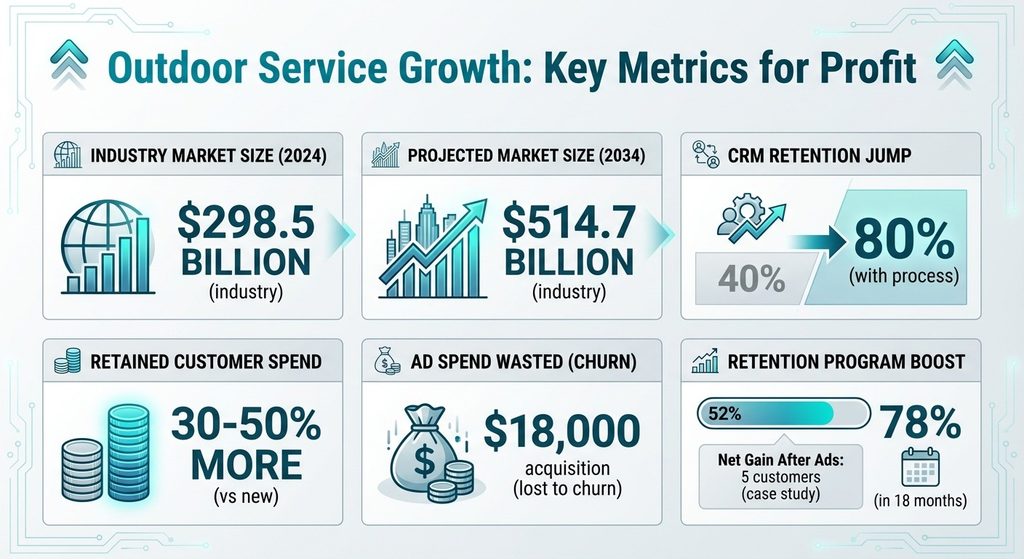
I’ve watched six landscaping companies this quarter alone chase growth through Facebook ads while their scheduling falls apart and last year’s customers quietly disappear. The market is expanding — industry projections show growth from USD 298.5 billion in 2024 to USD 514.7 billion by 2034—but most of that growth will flow to companies who’ve solved the retention and visibility problem.
The Contract Myth and the Chaos It Hides
Here’s the pattern I see in every initial consult:
- A crew that does beautiful work
- A calendar held together with text messages and memory
- A pricing model that changes based on who answers the phone
Then the owner tells me they’re losing bids to cheaper competitors or that customers “just don’t value quality anymore.”
The real issue isn’t the contract. It’s that without systems to set expectations, track service history, and demonstrate ROI, every job feels like a negotiation. Homeowners bail after one season because they never understood what they were buying, and the company never captured enough data to prove value or automate renewal conversations.
Contracts don’t create reliability—process does.
I’ve seen month-to-month programs with 80% retention because every visit was documented, photos were sent automatically, and customers received seasonal reports showing exactly what was done. I’ve also seen annual contracts with 40% churn because the service felt invisible until something went wrong.
The question isn’t how long you lock someone in. It’s whether you’ve built a system that makes staying the obvious choice.
What Retention Actually Costs (and Pays)
Let’s do the math that most landscaping companies skip.
| Metric | New Customer | Retained Customer |
|---|---|---|
| Acquisition cost | $150-$400 | Near zero |
| Estimating time | 60 minutes | 5 minutes |
| Route efficiency | Low (scattered) | High (clustered) |
| Annual spending increase | Baseline | +30-50% |
Acquiring a new residential maintenance customer costs $150-$400 when you factor in advertising, estimating time, and lost bids. That’s the number everyone focuses on—how to fill the pipeline.
In year two with a retained customer, acquisition cost drops to near zero. You already know the property, so estimating add-on work takes five minutes instead of an hour. Route efficiency improves because you’re not zigzagging across town.
And retained customers spend 30-50% more annually because trust is already established for seasonal projects, mulch refreshes, or addressing problems before they become emergencies.
The Real Cost of Churn
A client I worked with last year had 120 active accounts and added 60 new customers through a spring ad push. But they lost 55 customers from the previous year—most of whom never received a renewal conversation or any reason to remember why they’d hired this company. The net gain was five customers, and the owner had spent $18,000 on acquisition.
When we built a retention program with automated check-ins, photo documentation, and a simple CRM to flag accounts that hadn’t booked seasonal work, year-two retention jumped to 72%. The ad budget dropped by half, and revenue grew 23% because existing customers were buying more services.
Retention isn’t a feel-good metric. It’s the difference between profitable growth and expensive churn disguised as activity.
The Local Visibility System No One Wants to Hear About
Every landscaping company wants to rank on Google. Most think that means paying someone to “do SEO” and waiting for calls.
What actually works is less exciting and more methodical.
Claim and optimize your Google Business Profile with recent photos and consistent service categories. Get reviews from customers immediately after completing work. Publish localized content that answers the specific questions your market asks.
I’m talking about blog posts or service pages that address “spring cleanup timing in [your city]” or “drainage solutions for [local soil type].” Not because you’re trying to trick Google, but because homeowners search for these things and your competitors aren’t answering. When you combine that with a CRM that tracks which services each property has received, you can send targeted emails about seasonal needs that feel helpful instead of salesy.
SEO for landscaping requires treating your website like a tool that educates and qualifies, not a digital brochure. The companies winning local search are the ones publishing answers, collecting reviews systematically, and showing up in map results because their Google profile is actively managed.
It’s not magic. It’s discipline applied to the channels where your customers are already looking.
From Two Inquiries to Eighteen
One company I advised had a beautiful website that generated two inquiries a month. We didn’t redesign anything.
We added 12 service-area pages targeting nearby neighborhoods, optimized their Google profile with weekly posts and photos, and built a review-request workflow into their CRM that triggered three days after job completion.
Organic inquiries went from two to 18 per month within 90 days, and the quality improved because the content pre-qualified what kind of work they did and didn’t do.
CRM and Automation: The Unglamorous Backbone
This is where I lose half the room, because talking about CRM systems sounds like selling software instead of solving problems.
But here’s what I’ve seen in every successful outdoor service company: they know which customers are due for seasonal work, which properties have deferred maintenance building up, and which accounts haven’t been contacted in 90 days. They know this because a system tracks it.
What a Basic CRM Actually Needs to Do
A basic CRM for landscaping doesn’t need to be complicated. You need:
- Customer records with service history
- Automated reminders for seasonal outreach
- Tagging by service type for relevant offers
- Quick access to past work when customers call
When a customer calls asking about mulch, you should be able to see that they had drainage work done last year. When it’s time for fall cleanups, you should have a list of every customer who booked that service last year and a templated email ready to send.
Workflow automation handles the repetitive stuff that falls through the cracks. A new lead comes in, and the system sends a confirmation email. A job is marked complete, and the system sends a thank-you message with a review request. A customer hasn’t booked in six months, and the system flags them for a check-in call.
I worked with a three-crew operation that was losing track of which customers had received spring applications and which were overdue for pruning. They were running on a mix of paper invoices, a spreadsheet, and the owner’s memory. We moved them to a simple CRM with service tagging and automated seasonal reminders.
Within one season, they recovered $31,000 in services that customers wanted but had forgotten to schedule, and their administrative time dropped by about eight hours per week.
The ROI on CRM and automation isn’t in the software cost. It’s in the revenue you stop leaving on the table and the time you get back to actually run the business.
Building Programs That Customers Want to Keep
The difference between a one-time customer and a long-term relationship is whether you’ve designed a program that solves an ongoing problem or just sold a service.
Homeowners don’t wake up thinking about lawn care—they think about not wanting to worry about their yard and having a space they’re proud of. If your offering is “we’ll mow every week,” you’re competing on price. If your offering is “we’ll keep your property healthy year-round with a documented plan,” you’re solving a different problem.
What Makes Programs Stick
Programs work when they include:
- Visible milestones that show progress
- Proactive communication between visits
- Flexibility to pause or adjust without penalty
- Documentation with photos and reports
A seasonal maintenance program might include spring cleanup, monthly mowing, fall aeration, and winter prep—but the value comes from the mid-season check-in email with photos showing what was done, the heads-up about grub pressure in the area, and the option to pause service if they’re traveling. That’s what builds trust and makes renewal automatic.
The companies with 75%+ retention rates are the ones who make it easy to stay and who demonstrate value every month, not just at renewal time.
The Three-Tier Model That Worked
One client shifted from individual service sales to tiered maintenance programs:
| Tier | What’s Included | Result |
|---|---|---|
| Essentials | Mowing and trimming | Entry point for budget-conscious customers |
| Standard | Adds seasonal applications and cleanups | Most popular, balanced value |
| Premium | Includes design consultation and priority scheduling | Highest margin, deepest relationships |
Customers could switch tiers or pause seasonally. The result was higher average revenue per account, better route density, and retention that jumped from 52% to 78% in 18 months.
Measuring What Actually Matters
Most landscaping companies track revenue and maybe gross margin.
The ones that grow sustainably track customer lifetime value, retention rate by service type, cost per acquisition by channel, and route efficiency.
Customer lifetime value is simple: average annual spend multiplied by average retention in years. If your typical customer spends $2,400 per year and stays for 2.3 years, their lifetime value is $5,520. Now you know how much you can afford to spend acquiring them and which retention investments pay off.
If a CRM costs $1,200 annually but increases average retention from 2.3 to 3.1 years, you just added $1,920 in lifetime value per customer.
The Metrics That Change Decisions
Retention rate by service type shows you which offerings create stickiness. Customers who buy both maintenance and seasonal projects have 2-3x higher retention than maintenance-only customers. That insight changes your marketing.
Cost per acquisition by channel tells you where to invest. If Facebook ads cost $280 per customer and Google Local Services Ads cost $190, but Facebook customers have higher lifetime value because they’re buying design work, the cheaper channel isn’t necessarily better.
Route efficiency separates profitable companies from busy ones. If your crews are driving 40 minutes between jobs, you’re paying for windshield time instead of billable work. CRM data showing customer locations lets you build density—targeting neighborhoods where you already have accounts and declining work that’s geographically isolated unless the project size justifies the drive.
I helped a company analyze their acquisition sources and discovered that Nextdoor referrals had half the acquisition cost of paid ads and 40% higher retention. We shifted budget toward making it easy for existing customers to refer neighbors, and acquisition costs dropped 22% while quality improved.
The 12-Month Roadmap That Doesn’t Require Perfection
Here’s what sustainable growth looks like in practice, broken into quarters.
Q1: Foundation
Choose a CRM that fits your business size, migrate your customer data, and set up basic workflows for new leads and completed jobs. Claim and optimize your Google Business Profile. Start asking for reviews immediately after service.
The goal isn’t perfection—it’s creating the infrastructure that everything else builds on.
Q2: Retention Program
Launch a retention program. Identify your best customers and design a maintenance program that packages what they’re already buying with proactive seasonal services.
Offer it first to existing customers as an upgrade. Track who enrolls and what their feedback is.
Q3: Local Visibility
Publish content that answers common questions in your market. Build service-area pages for the neighborhoods you serve. Get aggressive about review collection—set a goal of 10 new reviews per month.
Track which channels are driving inquiries and which are driving qualified inquiries that convert.
Q4: Measure and Optimize
Pull your retention data, lifetime value, and cost per acquisition by channel. Identify what’s working and double down. Find the gaps—customers who haven’t booked seasonal work, neighborhoods with low density, services with high churn—and build targeted campaigns to address them.
This isn’t a sprint. It’s a system that compounds. Each quarter builds on the last, and by month 12 you have a business that’s measurably more valuable because it’s predictable, visible, and designed around retention.
What You Actually Need to Start
You don’t need a massive budget or a marketing team.
You need a decision to stop treating growth like a mystery and start treating it like a process with measurable inputs and outputs.
The starter kit:
- Pick a CRM that handles customer records, service history, and basic automation—most cost between $30 and $100 per month
- Claim your Google Business Profile and commit to updating it weekly with photos and posts
- Build one simple maintenance program with clear scope and pricing
- Create a review-request workflow that triggers after every job
- Track three metrics: retention rate, cost per new customer, and average revenue per account
That’s the foundation. Everything else—content marketing, paid ads, referral programs, advanced automation—builds on top of those basics.
The companies that win long-term aren’t the ones with the biggest ad budgets. They’re the ones who’ve built systems that deliver consistent value, communicate proactively, and make it easy for customers to stay year after year.
The market is growing, but the growth flows to the disciplined, not the loud.