
I spent three years watching my paint crew’s Facebook posts collect likes from other painters while homeowners kept calling the franchise down the street.
We’d share gorgeous exterior transformations, drop tips about sheen selection, even run boosted posts. The engagement looked decent. The phone stayed quiet.
The problem wasn’t our work—it was that we were shouting into a room where nobody was shopping. We were doing “marketing” without understanding the difference between broadcasting and being found when someone actually needs a painter. That’s the gap between outbound noise and inbound systems, and it’s costing residential painters thousands in lost revenue every shoulder season.
The “Post and Pray” Trap Most Painters Fall Into
Here’s the pattern I see in every contractor Facebook group: someone shares their latest color-matched trim work, waits for the phone to ring, then wonders why they’re getting crickets while spending money on Google Ads that “ate my budget” without delivering qualified leads.
They’re not lazy—they’re just doing random acts of marketing instead of building a system that captures people already searching for help.
What Makes Inbound Different
Traditional advertising interrupts people who aren’t thinking about painting. You’re buying attention: a radio spot during someone’s commute, a door hanger they toss.
Inbound marketing positions you where homeowners go when they’re ready to hire.
It’s the difference between knocking on doors asking “Need painting?” and being the first credible option when someone Googles “exterior painter near me” on a Saturday morning after noticing their siding is peeling.
Most painters I coach are mixing both approaches without realizing it, then blaming “digital marketing” when the scattered tactics don’t stack into results.
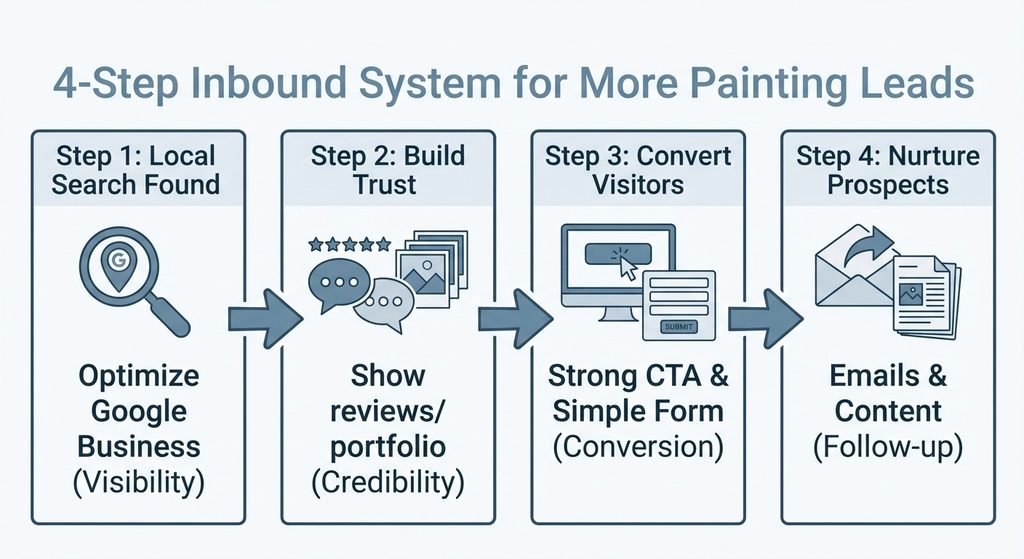
The Four-Stage Inbound System That Fits Between Estimates
When I transitioned from estimator to helping other painting crews fix their lead flow, I needed a framework simple enough to execute during the gaps between job walks. No agency retainers, no full-time social media manager—just a repeatable sequence that works with how residential painters actually operate.
Stage One: Being Found Locally
This is where most painters lose the game before it starts.
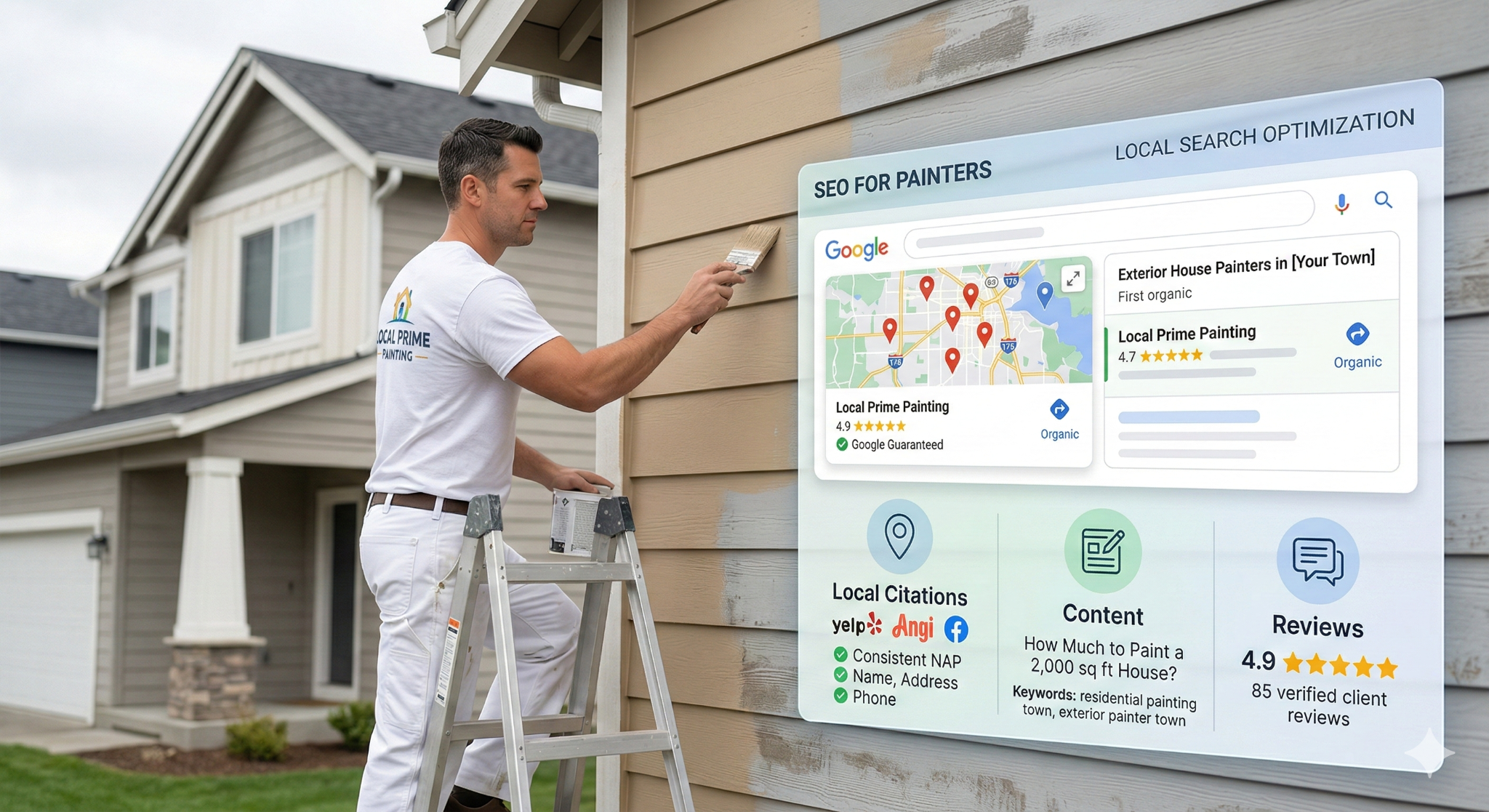
When a homeowner searches “painters in [your town]” or “interior painting near me,” Google decides who shows up based on your Google Business Profile completeness, local citation consistency, and basic seo for painters fundamentals. If your GBP is half-filled, your NAP (name, address, phone) doesn’t match across directories, or your website lacks location-specific content, you’re invisible to ready-to-hire homeowners.
I watched a two-truck operation go from four estimates a month to twelve just by claiming and optimizing their Google Business Profile—adding service areas, uploading twenty project photos with captions, posting weekly updates, and getting their info consistent across local directories.
No ads. No fancy funnel. Just showing up where people were already looking.
Stage Two: Earning Trust Before the Phone Rings
Once someone finds you, they’re vetting. They’ll click through to your website, scan your reviews, look at your portfolio. This is where painters either convert browsers into callers or watch them bounce to a competitor.
Your trust-building assets need to answer the silent questions every homeowner has:
- Can they handle my specific project?
- Do other people vouch for them?
- Are they legitimate and professional?
Your portfolio isn’t just pretty pictures—it’s proof you’ve solved problems like theirs. Show the dated kitchen you transformed with cabinet painting. The exterior where you matched historic colors.
Pair each project with a short story: the challenge, your approach, the result.
Testimonials work the same way—specific beats generic. “They protected all my furniture and finished our living room in three days without any paint smell lingering” tells a better story than “Great service, highly recommend!”
Stage Three: Converting Visitors Into Leads
This is where I see the most money left on the table. A painter will invest in a decent website, drive traffic to it, then lose prospects because the site doesn’t make it easy to take the next step.
Your website needs to be mobile-responsive (most homeowners browse on their phone), load fast, and have a clear call-to-action above the fold.
| Essential Form Fields | Why It Matters |
|---|---|
| Name | Basic contact info |
| Follow-up capability | |
| Phone | Immediate connection |
| Zip code | Service area verification |
| Project description | Qualification filter |
Don’t make them fill out twelve fields—save that for the estimate. Your CTA language matters too. “Get Your Free Estimate” converts better than a generic “Contact Us” button because it’s specific and low-risk.
One crew I worked with was getting site traffic but almost no form fills. We added a simple lead magnet—a PDF guide called “5 Questions to Ask Before Hiring a Painter”—and made the CTA “Download Free Guide + Get Estimate.”
Their conversion rate jumped from 2% to 6% overnight.
Stage Four: Nurturing Prospects Who Aren’t Ready Yet
Not everyone who finds you is ready to hire today. Maybe they’re still getting quotes, waiting for spring, or need to finish another project first. If you don’t have a way to stay in touch, they’ll forget you exist.
That’s where a simple email newsletter and blog content create long-term value.
A monthly newsletter with one project spotlight, one seasonal tip, and a reminder that you’re booking for the next season keeps you top-of-mind.
Your blog doesn’t need to be fancy—three to four posts a quarter answering common questions positions you as the local authority and gives you content to share.
The email list builds naturally:
- Every estimate gets added (with permission)
- Every lead magnet download
- Every past customer who opts in for maintenance reminders
Over time, this becomes your most valuable asset—a direct line to people who’ve already raised their hand.
Where Painters Waste Money (And How to Stop)
The biggest budget killer I see is Google Ads without the foundation in place.
A painter will spend $800 a month on pay-per-click ads, send traffic to a website that doesn’t convert, and blame Google for “not working.” The ad platform isn’t the problem—it’s that you’re paying for clicks when your site can’t turn those clicks into calls.
Before you spend a dollar on paid traffic, make sure your Google Business Profile is fully optimized, your website has a clear conversion path, and you’re collecting reviews. I’ve seen crews cut their ad spend in half and double their lead volume just by fixing the conversion assets first.
The Lead Aggregator Math Problem
Another money pit: paying for leads from aggregator sites like HomeAdvisor or Thumbtack without understanding the math.
If you’re spending $40 per lead and closing 20% of estimates, each job costs you $200 in lead fees before you even account for your time. Compare that to a homeowner who finds you through your Google Business Profile—zero acquisition cost, and they’re usually higher-intent because they sought you out.
I’m not saying lead services are always bad, but they shouldn’t be your primary strategy. Your inbound system should be generating enough organic inquiries that you’re selective about which paid channels you layer on top.
The 30-Day Inbound Starter Checklist for Painting Contractors
If you’re reading this between estimates or during a slow week, here’s the sequence that gets you from “posting and praying” to actually attracting qualified leads.
Don’t try to do everything at once—knock out one section per week and you’ll have a functional system in a month.
Week One: Claim and Optimize Your Google Business Profile
Log into Google Business (or claim your listing if you haven’t), and fill out every single field. Add your service areas, business hours, website link, and a keyword-rich description like “residential painting contractor serving [your towns] with interior and exterior painting, cabinet refinishing, and color consultation.”
Upload at least fifteen photos showing different project types—exteriors, interiors, trim work, before-and-afters. Write captions for each: “Historic home exterior restoration in [neighborhood]” or “Kitchen cabinet painting transformation in [town].”
Set up Google Posts to share weekly updates.
Every time you finish a job, snap a photo and post it with a short description. This signals to Google that you’re active and relevant. Enable messaging so homeowners can reach you directly through your profile.
Week Two: Audit and Fix Your Local Citations
Search for your business name on Google and check the top directories: Yelp, Angi, Facebook, Nextdoor, Yellow Pages, Bing Places. Make sure your name, address, and phone number are identical across all of them.
Even small inconsistencies—like “St.” versus “Street”—confuse search engines and hurt your local ranking.
If you find incorrect listings, claim them and update the info. If you’re not listed on a directory, add yourself. This is tedious work, but it’s foundational. Think of it like surface prep—you can’t get a smooth finish without doing the boring groundwork first.
Week Three: Build or Fix Your Website Conversion Path
If you don’t have a website, use a simple builder like Squarespace or Wix.
If you have a site, audit it on your phone.
Ask yourself:
- Does it load in under three seconds?
- Is there a clear “Get Free Estimate” button at the top?
- Can someone fill out a contact form without scrolling forever?
Add a dedicated Services page with location-specific keywords: “interior painting in [your town],” “exterior house painting in [county].” Create a Portfolio page with at least ten projects, each with a photo and two-sentence description. Add a Testimonials page with five to ten reviews.
Make sure your contact form is simple: name, email, phone, zip code, project type (dropdown: interior, exterior, cabinets, other), and a message box. Test it yourself to confirm submissions actually reach you.
Week Four: Start Your Email List and Content Engine
Set up a free email service like Mailchimp or ConvertKit. Add every past customer who gave you permission, plus anyone who fills out your contact form going forward.
Send a simple monthly email:
- One project story with photos
- One seasonal tip
- A call-to-action like “We’re booking for spring—reply to this email for priority scheduling”
Write your first blog post answering a question you get on every estimate. “How much does it cost to paint a 2,000 sq ft house interior?” or “What’s the best paint for high-humidity bathrooms?” Keep it to 600-800 words, use your real voice, and include a CTA at the end directing people to your estimate form.
Publish it on your website and share the link in your next email and GBP post.
When You’ll Actually See Results (And What to Track)
Here’s the honest timeline: if you execute this system consistently, expect to see your first organic leads within three to six weeks.
Google Business Profile optimization usually kicks in fastest—I’ve had crews get estimate requests within ten days of uploading photos and posts. Website traffic and conversions build more slowly, and email nurturing pays off over months, not days.
The Three Numbers That Matter
Track these weekly:
- GBP views and actions (Google tells you this in your dashboard)
- Website visits and form submissions (use Google Analytics, it’s free)
- Email open rates
If GBP views are climbing but you’re not getting calls, your profile needs better photos or clearer service descriptions. If website traffic is up but conversions are flat, your CTA or form is the problem.
Don’t obsess over vanity metrics like social media followers or blog page views.
The only number that matters is qualified leads—people who contact you ready to get an estimate for a real project.
Your Next Move
If you’re still relying on word-of-mouth and hoping the phone rings, you’re one slow season away from panic.
The good news: you don’t need a marketing degree or a big budget to build an inbound system that works. You need to show up where homeowners are already searching, prove you’re credible before they call, make it easy to take the next step, and stay in touch until they’re ready.
Start with your Google Business Profile this week. Claim it, fill it out completely, upload fifteen project photos. That one action will put you ahead of 60% of your local competitors and start generating leads while you’re out doing estimates.