I used to think the guys getting all the calls were just lucky—better truck, better connections, or maybe they’d been around longer.
Then my phone went quiet for three weeks straight in peak season, and I watched a competitor who’d been in business six months get tagged in a dozen Facebook posts while I was grinding 12-hour days and getting ghosted.
That’s when I stopped blaming “the algorithm” and started treating visibility like a jobsite: break it down, fix what’s broken first, then build on solid ground.
The Three Lies Keeping You Invisible
Most advice you’ll find online falls into one of three categories, and all of them waste your time if you’re a small operator trying to fill your schedule.
Lie #1: “Just post on social media.”
I posted before-and-after shots on Facebook for eight months. Got likes from my mom and two other lawn guys. Zero calls.
Why? Because posting without local intent is like handing out business cards in an empty parking lot. The ones ready to hire are typing “lawn service near me” into Google at 9 PM on a Tuesday.
Lie #2: “You need a big marketing budget.”
The competitor I mentioned? His entire visibility system cost him maybe $200/month and two hours weekly. He wasn’t outspending me—he was out-organizing me.
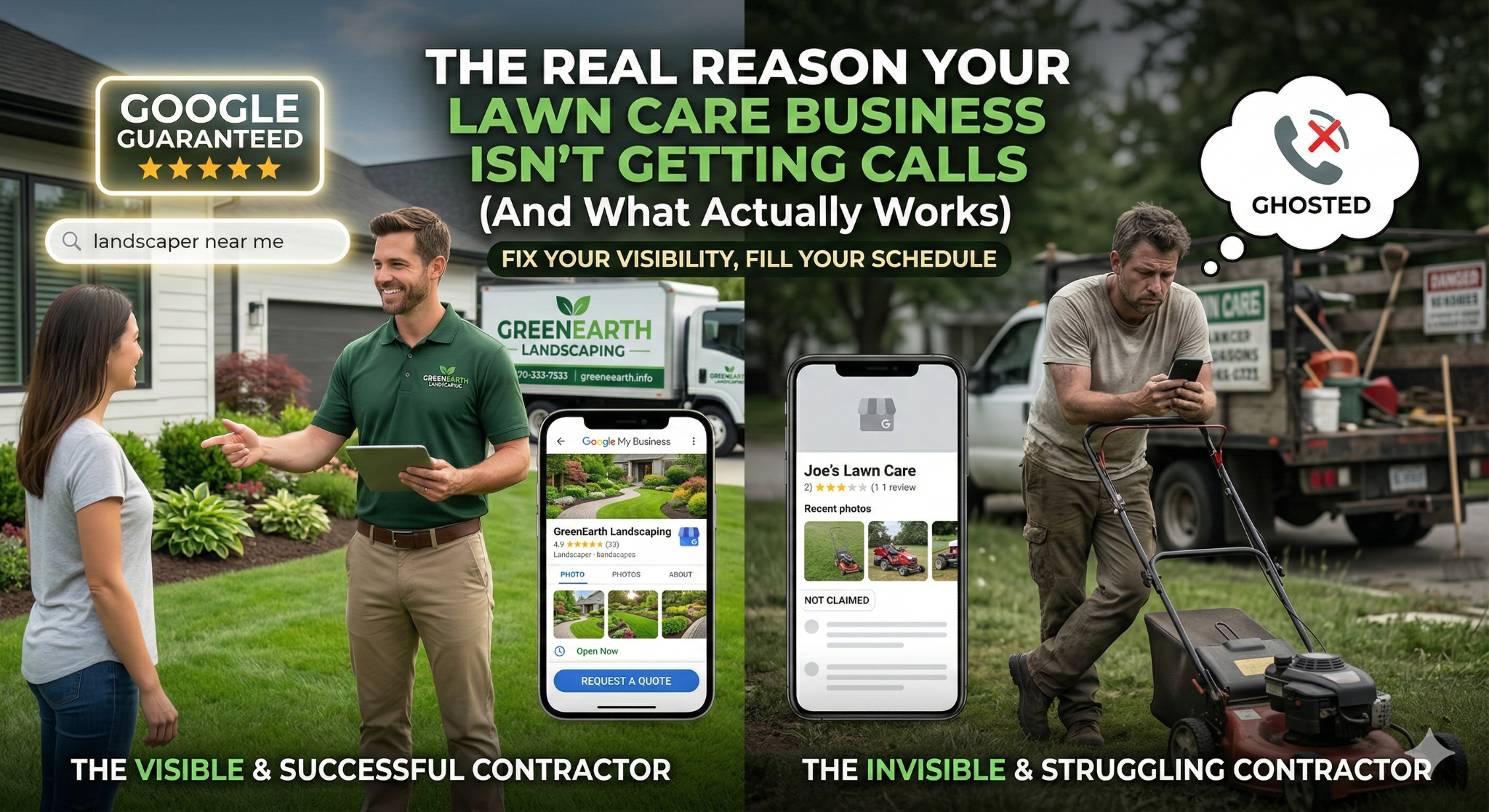
His Google My Business profile was dialed in, his reviews were recent, and his Local Service Ads were targeted to zip codes where he actually wanted to work.
Lie #3: “Set up Google My Business and wait.”
I see guys in contractor groups every week asking why their profile “isn’t working” when they haven’t touched it since the day they claimed it.
Google rewards activity and completeness, not just existence.
How Customers Actually Find Lawn Care (The Three-Step Reality)
Here’s what changed everything for me: I stopped trying to be everywhere and started focusing on the exact path a homeowner takes when they need lawn care.
| Customer Journey Stage | What’s Happening | What You Need |
|---|---|---|
| The Search | Someone types “lawn mowing service [your town]” or “landscaping near me” into Google | Complete, current GMB profile loaded with the right signals |
| The Trust Check | They scan your reviews, look at photos, verify you match their property type | Recent reviews, relevant photos, professional presentation |
| The Decision Trigger | Something tips them from “maybe” to “I’m calling this guy” | Combination of five-star reviews, quality photos, easy quote process, Google Guaranteed badge |
If your Google My Business profile isn’t complete, current, and loaded with the right signals, you’re invisible in that moment. And that moment is when they’re ready to call.
The lawn care industry is expanding—market forecasts show steady growth over the next decade—which means more competition for those high-intent searches.
Google My Business: The One Thing You Can’t Half-Do
If your GMB profile isn’t 100% complete and updated weekly, you’re losing to guys who might not even mow as well as you do.
Start with NAP consistency. Name, Address, Phone number must match exactly across your GMB, website, Yelp, Facebook, and every directory listing. Not “Joe’s Lawn Care” on one and “Joe’s Lawn & Landscape” on another.
Google sees that as two different businesses and splits your authority. I spent a Saturday afternoon fixing mine across 11 platforms, and my map ranking jumped within two weeks.
Categories matter more than you think.
Your primary category should be exactly what you do most—”Lawn Care Service” or “Landscaper”—and then add secondary categories that match actual services. Don’t pick categories hoping to game the system; pick what you actually deliver.
Photos are your 24/7 crew. I upload 3-5 geotagged photos every week: finished jobs, equipment in action, seasonal work. Why geotagged? Because Google uses EXIF data to confirm you’re actually working in the area you claim to serve.
Take the photo on your phone at the jobsite, upload it that night. It takes three minutes and signals freshness to Google’s algorithm.
The Weekly GMB Maintenance Routine
Monday morning posts. Every Monday, I post a quick update—a seasonal tip, a recent project, a special offer. “Spring aeration season is here—book now for healthier grass this summer” with a photo. Google ranks active profiles higher than dormant ones.
The Q&A section is free real estate. I added five common questions (“Do you offer one-time mowing?” “What areas do you serve?”) and answered them with keywords and clear info.
It shows up in search results and gives people confidence you’re responsive.
Google Reviews: The System That Runs Itself (Once You Build It)
I used to ask for reviews and get nothing. Then I realized I was asking wrong.
The Review Request Formula That Actually Works
- Wait two days after job completion. Don’t ask when you’re packing up the truck.
- Send this exact text: “Hey [Name], hope the yard’s looking great. If you’re happy with the work, would you mind leaving a quick review? Here’s the link: [direct GMB review link].”
- Make it stupid simple. That direct link is critical. If they have to search for your business, you’ve lost them.
My response rate went from maybe 10% to over 60% with this approach.
Respond to every review, especially the bad ones. I got a three-star review last year because we missed a section behind the shed. I responded publicly, apologized, explained we’d fix it free, and followed through.
The customer updated it to five stars, but more importantly, ten other people saw I handle problems professionally.
Why Fresh Reviews Beat Old Ones
Volume and recency beat perfection. Five reviews from this month outrank 50 reviews from two years ago. Google wants to see you’re actively earning trust, not coasting on old reputation.
I aim for two new reviews per week during season. Some weeks I get four, some I get zero, but the consistency compounds.
Local Service Ads: Paid Visibility That Actually Converts
I resisted LSAs for a year because I thought “pay-to-play” meant Google was screwing the little guy. Then I ran the numbers.
You only pay for actual leads. Not impressions, not clicks—phone calls and message requests from people in your service area actively looking for lawn care. My average cost per lead is $18-25. If I close one in three, I’m paying $54-75 to acquire a customer worth $800-2000 annually.
That math works.
What Makes LSAs Different From Regular Ads
- The Google Guarantee badge builds instant trust. When you’re LSA verified (background check, license verification, insurance), you get the green checkmark. Homeowners see that and feel safer calling you over an unverified competitor.
- You control the budget and geography. I run $200/week during peak season, $50/week in winter. I target three zip codes where I want to work and exclude the rest.
- The dashboard shows exactly what you’re getting: number of leads, cost per lead, booking rate.
I check the app every morning, respond to leads within an hour (speed matters—first responder usually wins), and pause the ads when my schedule is full.
Where to Focus Your Limited Time: The Visibility Allocation Framework
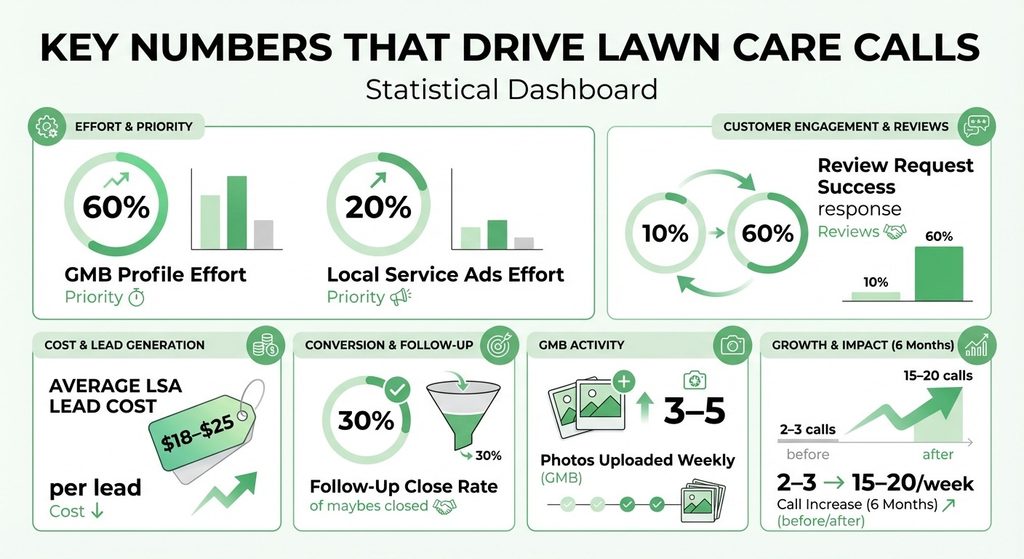
You’ve got maybe 5-10 hours a month for marketing if you’re running jobs, doing estimates, and handling equipment. Here’s how I’d allocate it based on what actually drives calls.
The 60-20-10-10 Split
Google My Business and Google Reviews: 60% of your effort.
This is your foundation. Complete profile, weekly photos, consistent review requests, monthly posts. If you do nothing else, do this.
Local Service Ads: 20% of your effort.
Setup takes a few hours (background check, profile build), then it’s daily lead response and weekly budget tweaks. The ROI is immediate if you’re in a market with decent search volume.
Website and contact forms: 10% of your effort.
You need a simple site with your services, service area, phone number, and a contact form. Mine is a $300 template I customized in a weekend. The form captures leads when people aren’t ready to call but want a quote.
Directories (Yelp, Angie’s List, Thumbtack): 5% of your effort.
Claim your profiles, make sure NAP is consistent, respond to reviews. Don’t spend money on Yelp ads or Thumbtack credits unless you’ve maxed out GMB and LSAs first.
What About Social Media and SEO?
Facebook and social media: 5% of your effort. Organic social media is mostly a waste for lead generation. It’s good for staying top-of-mind with existing customers and referrals, but the people scrolling aren’t in buying mode.
If you post, make it quick—job photos, seasonal tips, customer shout-outs.
SEO and content marketing: 0% unless you’re trying to scale regionally. For a 2-truck operation serving a town or county, your GMB optimization is your local SEO.
Don’t let an agency sell you a $1500/month SEO package when you haven’t nailed the free stuff.
The U.S. lawn care market continues growing, which means the fundamentals—being findable, trustworthy, and responsive—matter more than ever.
The Follow-Up System Nobody Talks About
Most guys lose money here: they get the lead, give the estimate, then… nothing.
I built a simple follow-up sequence that closes 30% of those maybes:
Day 3 after estimate: Text saying “Hey [Name], wanted to check if you had any questions about the estimate I sent over.”
Day 7: “Hi [Name], just following up one more time. If you’re still interested, I’ve got availability next week.”
Day 30: “Hey [Name], hope your yard’s doing well. We’re booking for [next season/service]. Let me know if you’d like to get on the schedule.”
That’s it. Three touches, all respectful, all adding value.
I close 1 in 3 of these follow-ups, which means I’m turning “lost” estimates into $15-20K in annual revenue.
When Visibility Isn’t the Problem
Sometimes the phone rings and you still don’t get the job. That’s a different issue.
If you’re getting calls but not closing: Your pricing might be off, your estimate process might feel unprofessional, or you’re not communicating value. Record yourself giving an estimate and listen back.
If you’re getting calls from the wrong customers: Tighten your service area in GMB and LSAs. I cut my service radius from 30 miles to 15 and my profit per job went up 40%.
If your reviews are stuck at 3.5 stars: You’ve got a service quality issue, not a visibility issue. Fix the work first, then rebuild reputation.
Your 30-Day Visibility Checklist
Here’s what I’d do if I were starting from zero today, in order of impact:
Week 1: Foundation
- Claim and complete your Google My Business profile—every field, every category, 10+ photos, business hours, service area
- Fix NAP consistency across your website, Facebook, and any directories where you’re listed
- Set up a direct review link and save it in your phone
Week 2: Reviews and Activity
- Request reviews from your last 10 jobs using the text template above
- Respond to every review you have, even the old ones
- Upload 5-10 more photos showing variety
- Post your first GMB update
Week 3: Expansion
- Apply for Google Local Service Ads (background check takes a few days)
- While waiting, build or update your website with a simple contact form
- Add your GMB link and review link to your email signature and text templates
Week 4: Launch and Systematize
- Launch LSAs with a $50/week test budget in your core zip codes
- Set up your follow-up sequence for estimates
- Upload three new photos to GMB and post another update
Then repeat the weekly habits: photos, posts, review requests, lead response, follow-ups. That’s the system.
The lawn care industry is growing—industry projections confirm steady expansion—but that growth doesn’t automatically fill your schedule. You have to be findable when someone’s ready to hire.
What Changed for Me (And What It Might Mean for You)
Six months after I started treating visibility like a jobsite checklist, my phone went from 2-3 calls per week to 15-20.
I’m not special. I didn’t hire an agency or spend a fortune. I just stopped doing random marketing tasks and started doing the right ones in the right order.
The competitor with the clean truck? He’s still getting tagged on Facebook. But now I’m the one showing up first in Google Maps, with 87 five-star reviews, a Google Guarantee badge, and a contact form that converts browsers into bookings.
If you’re grinding all day and wondering why the calls dried up, it’s probably not your work—it’s that nobody can find you when they’re ready to hire. Fix that, and everything else gets easier. For more structured guidance on optimizing your online presence, check out these landscaping seo services strategies that align with what actually works for small operators.
Start with Google My Business tonight. Complete it, upload photos, ask for one review.
That’s the foundation. Everything else builds from there.